Pendant longtemps, le nom de Lydie Marie Joseph Labart tenait dans quelques lignes : une naissance à Saint-Amand, une union avec Amand Joseph Wauthy, trois enfants connus et une mort survenue beaucoup trop tôt. La famille avait gardé une phrase, simple et terrible : Lydie serait morte « de tristesse » après la perte d’un enfant.
Il manquait pourtant quelque chose d’essentiel : son visage. Le portrait rattaché à sa fiche Geneanet permet aujourd’hui de regarder cette jeune femme autrement que comme une suite de dates. L’image ne dit ni le jour où elle fut prise, ni le nom du photographe. Elle donne au moins une présence à celle que l’histoire familiale n’avait pas oubliée.
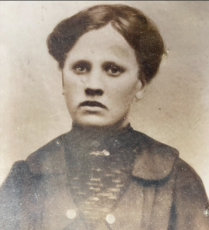
Naître à Saint-Amand en 1892
L’arbre familial situe la naissance de Lydie au jeudi 24 novembre 1892, à Saint-Amand, dans le Hainaut. Son acte de naissance n’a pas encore été lu dans le projet : la date est concordante dans les arbres consultés, mais elle doit encore être reliée à l’image ou à la référence précise de l’acte.
Les Archives de l’État décrivent alors Saint-Amand comme une petite commune rurale de 1 176 habitants en 1890, reliée à la chaussée de Charleroi à Namur par un chemin de terre et dominée par l’agriculture. Des carrières de pierre et de chaux complétaient cette économie. Ce paysage de champs, de chemins et de villages voisins forma le premier monde de Lydie.
La table décennale officielle des naissances de Saint-Amand pour 1891–1900 est bien conservée et signalée en ligne. Elle constitue la prochaine porte d’entrée pour retrouver la référence exacte de la naissance de Lydie.
Les Labart et les Vassart
Dans l’arbre de travail, Lydie est la fille de Joseph Ghislain Labart, né en 1850 et mort vers 1915, et de Clémence Ghislaine Vassart, née en 1853. Ces identités structurent la branche, mais les actes correspondants doivent encore être joints au dossier.
Ses grands-parents paternels y sont nommés Casimir Joseph Labart (1821–1892) et Marie-Thérèse Marmier (1821–1887), mariés en 1846. Du côté maternel apparaissent Joseph Vassart (1822–1897) et Marie Catherine Linet (1826–1858), mariés en 1851.
Lydie et Amand
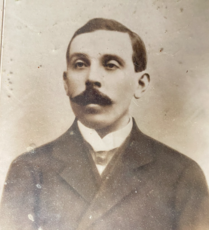
Lydie partage sa vie avec Amand Joseph Wauthy, né à Wagnelée le 23 août 1887. La date et le lieu de leur mariage ne sont pas encore établis dans le dossier. Le portrait d’Amand le montre en costume, le regard droit, avec cette solennité particulière des photographies du début du XXe siècle.
Trois enfants sont aujourd’hui nommés dans l’arbre : Paula Wauthy, née en 1919 et décédée en 2008 ; Alice Wauthy, dont les dates restent à retrouver ; et Alexandre Wauthy, né en 1921. Paula deviendra la grand-mère maternelle de Johnny Deman.
Amand survécut longtemps à Lydie. Il mourut à Marbais le 26 décembre 1955, à l’âge de 68 ans. Les actes de naissance, de mariage et de décès du couple permettraient de préciser leurs domiciles, leurs professions et la chronologie exacte de leur vie commune.
« De tristesse »
La tradition familiale racontait que Lydie avait perdu un jeune enfant, puis s’était éteinte en clinique vers 1930. Pendant des décennies, la famille résuma le drame par les mots « de tristesse ». Cette expression n’est pas un diagnostic ; elle est la forme affective sous laquelle le souvenir a traversé les générations.
Une lettre datée du 14 novembre 1994, adressée à Suzette Wauthy par le docteur P. Even, alors médecin-chef de l’Institut psychiatrique de Saint-Servais, apporte un éclairage important. Le médecin explique que la grand-mère de Suzette avait souffert d’une dépression profonde après la perte d’un enfant, qu’elle avait cessé de s’alimenter et qu’elle avait été internée pendant les trois derniers mois de sa vie.
Suzette étant la fille d’un frère de Paula, Johnny a confirmé que la grand-mère évoquée dans ce cadre familial était Lydie. L’identification est cohérente, mais le nom de Lydie ne figure pas dans la lettre. La pièce ne donne pas davantage la date précise du décès, son lieu exact ni la référence d’un dossier hospitalier.
La lettre ne remplace pas l’acte de décès. Elle transforme toutefois une phrase familiale en un récit médicalement vraisemblable, sans effacer la douleur contenue dans les mots « de tristesse ».
L’histoire officielle du Beau Vallon rappelle qu’un asile destiné aux femmes et aux enfants indigents fut fondé sur les hauteurs de Saint-Servais en 1914 et agrandi entre 1923 et 1925. Ce contexte éclaire l’histoire de la psychiatrie locale, mais il ne prouve pas, à lui seul, que Lydie fut soignée dans cet établissement précis.
Les enfants après Lydie
La mémoire familiale rapporte qu’après la mort de leur mère, Paula, son frère et sa sœur furent élevés par des religieuses dans un orphelinat. L’établissement n’est pas encore identifié et aucun registre d’admission n’a été retrouvé.
Cette rupture aide pourtant à comprendre la place de Lydie dans le récit familial. Sa disparition ne fut pas seulement la fin d’une jeune vie : elle réorganisa brutalement l’enfance de ceux qui restaient. Paula en sortit avec une force que ses descendants ont continué à reconnaître en elle.
Ce que nous savons — et ce qui reste à retrouver
Deux portraits rendent désormais au couple un visage. L’arbre fournit une structure familiale cohérente. La lettre de 1994 corrobore fortement les circonstances transmises autour de la mort de Lydie. Mais les pièces décisives manquent encore.
Raconter Lydie aujourd’hui, ce n’est pas fermer le dossier par une belle histoire. C’est réunir ce qui peut l’être, laisser les inconnues visibles et ne jamais confondre l’amour familial avec une preuve documentaire. Son visage est revenu. Les actes, eux, restent encore à chercher.