À Klemskerke, la mémoire des Borny tient dans deux paysages. Le premier est vertical : la haute silhouette de bois d’un moulin à pivot, dressée au-dessus des maisons et des haies. Le second est horizontal : la plage de Vosseslag, la mer du Nord et ses bancs de sable que la marée recouvre parfois plus vite que les hommes ne peuvent revenir.
Entre ces deux horizons se dessine une famille de meuniers, de cultivateurs, de journaliers et de pêcheurs à pied. Les photographies retrouvées donnent aujourd’hui un visage à ce récit. Elles permettent aussi de raconter l’histoire avec davantage de justesse, sans confondre la mémoire familiale avec ce que les sources prouvent réellement.
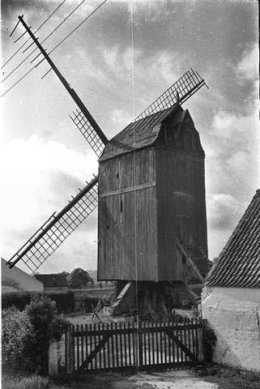
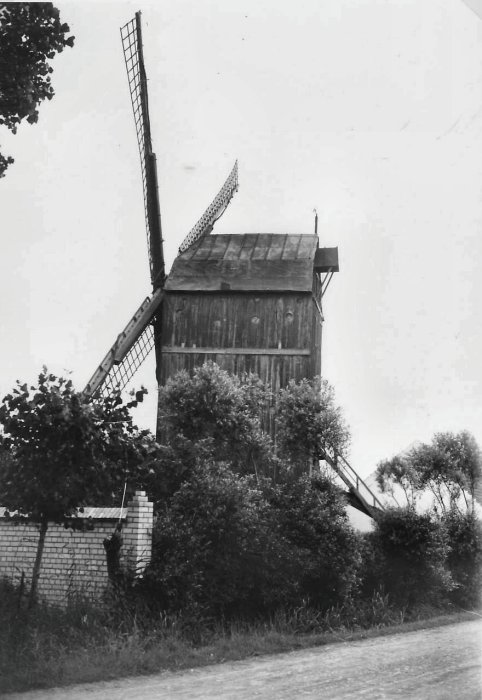
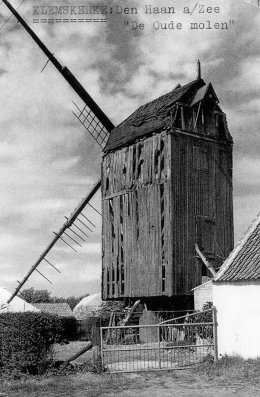
Le moulin qui prit le nom des Borny
La base belge Molenecho’s situe ce moulin à pivot au 11 Batterijstraat, sur la parcelle cadastrale D202e. Il fut construit en 1863 sur un terrain du Bureau de bienfaisance de Klemskerke, pour l’agriculteur Hubert Joseph Vanbesien. Il s’agissait d’un moulin à farine en bois, à trois étages.
Le 30 septembre 1910, il fut vendu devant le notaire Tanger à Charles Louis Borny, meunier à Klemskerke, époux de Rosalie Vandenberghe. Charles Louis mourut le 14 février 1911 et le moulin passa à sa veuve et à leurs enfants. Rosalie se remaria ensuite avec Amand Couzyn.
Le 13 octobre 1933, le moulin fut vendu à Georges Maurice Borny, cultivateur à Klemskerke, époux de Pockelé. Il fut protégé comme monument le 26 août 1943. Très endommagé par la tempête de 1953 et déjà fortement délabré, il s’effondra pendant une tempête en avril 1954. Sa protection fut officiellement levée en 1956, après constat de sa disparition.
La maison du meunier, appelée Molenrust, existe encore. La base patrimoniale signale aussi la grange et l’étable attenantes ainsi qu’une pierre meulière conservée contre la façade. Le terrain de l’ancien moulin reste accessible par une grille métallique — la même présence familière que l’on distingue sur les photographies anciennes.
Le moulin n’est plus debout, mais ses photographies rendent à la branche Borny un morceau de son paysage.
Une famille de Klemskerke
L’arbre Geneanet de Johnny Deman identifie les parents de Michel Marcel Léopold Borny comme Theophile Louis Borny et Emilie Lannoye. Les portraits transmis par Johnny correspondent aux médias attachés à leurs fiches Geneanet.
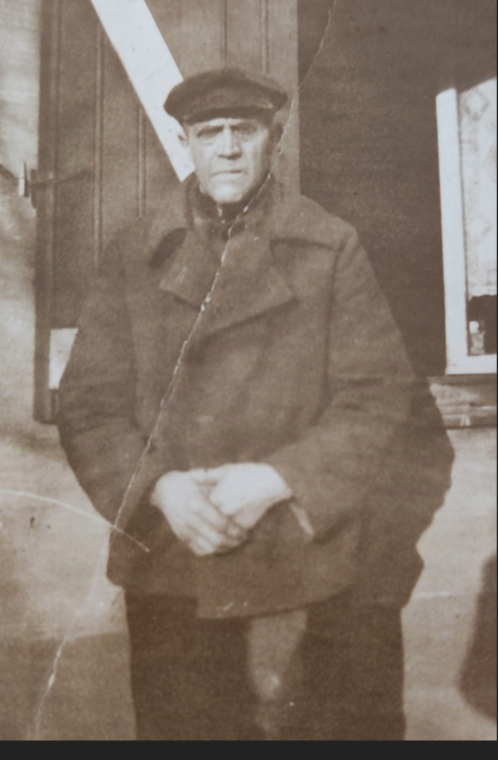
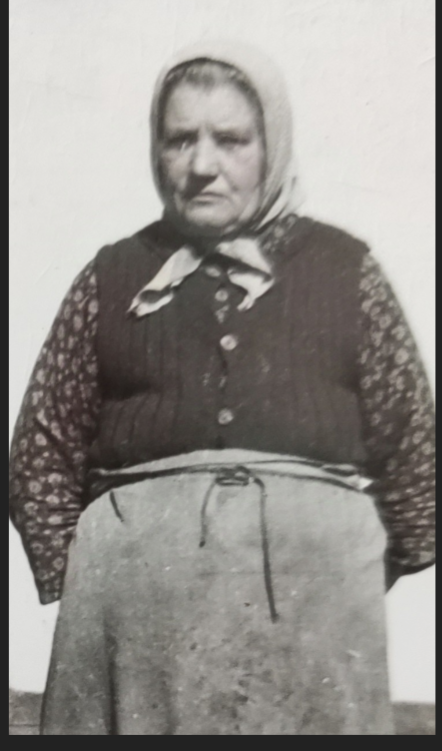
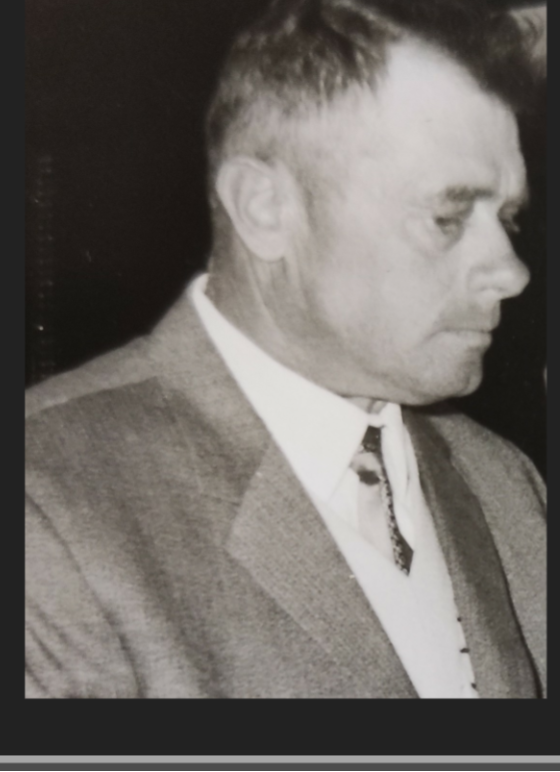
Selon cet arbre, Theophile Louis naquit le 25 février 1874 à Klemskerke et y mourut le 4 novembre 1945. Il est décrit comme dagloner, c’est-à-dire journalier. Emilie naquit le 27 janvier 1875 à Klemskerke et y mourut le 6 juillet 1959. Leur mariage est donné au 12 janvier 1899, toujours à Klemskerke.
Michel Marcel Léopold naquit le 25 février 1914 à Klemskerke et mourut le 12 août 2013 à Ostende, à l’âge de quatre-vingt-dix-neuf ans. Dans le dossier de travail de Johnny, il est le père biologique confirmé de Jean-Marie Deman : cette filiation repose sur l’aveu direct fait par Michel Marcel à son fils. Elle constitue une certitude familiale, distincte d’une reconnaissance juridique ou d’une preuve génétique.
En 1929, sur le cinquième banc
Un ancien résumé familial parlait d’un bateau de pêche chaviré dans une tempête. La transcription néerlandaise d’un article de presse contemporain raconte autre chose. Le drame ne se déroule pas à bord d’un bateau, mais sur un banc de sable découvert à marée basse, en face de Vosseslag.
Jeroom et Pieter Borny s’étaient rendus sur le cinquième banc pour chercher des appâts. François, Ingelbertus et Oscar Borny s’y trouvaient également avec un cheval et une charrette. Pieter regagna seul la côte à pied.
Vers 9 h 45, alors que l’eau était déjà haute, les autres tentèrent de revenir avec la charrette. Le cheval perdit pied. Emportée et déséquilibrée, la voiture pivota puis fut submergée. Jeroom sauta et rejoignit la terre à la nage.
Oscar parvint à saisir son fils Henri et à nager avec lui vers la plage. Jeroom, retourné dans l’eau, les aida avant d’essayer de rejoindre François et Ingelbertus. Épuisé ou pris d’un malaise, il dut renoncer. Ingelbertus, qui ne savait pas nager, s’était agrippé à François. Les deux hommes se noyèrent ensemble.
Le texte conservé affirme que le corps d’Ingelbertus fut repêché vers 10 h 10, tandis que François restait introuvable malgré les recherches menées en bateau. Cette transcription est la source la plus proche d’un compte rendu contemporain actuellement disponible, mais le journal, la date de publication et la page n’ont pas encore été identifiés.
« Den Amerikaander », l’épave sous le sable
Une recherche complémentaire a retrouvé deux récits d’histoire locale qui apportent un élément absent de la transcription : la charrette aurait été entraînée dans une ancienne épave enfouie devant Vosseslag, connue sous le surnom de « Den Amerikaander ». Une kelle — le creux séparant deux bancs de sable — se serait remplie avec la marée, masquant le piège.
Dans Scheepsrampen voor de “Vlaamsche” kust — Deel VIII, publié en 1990, Erik F. Baeyens rattache cette épave au trois-mâts américain Plutarch, naufragé en 1859. Il raconte que cinq hommes étaient partis de nuit avec un cheval et une charrette pour chercher des vers servant d’appâts. Le brouillard leur aurait fait perdre leur route. Il nomme les victimes Engel Borny, âgé de 40 ans, et son neveu Frans Borny, 18 ans. Selon ce récit, le corps d’Engel aurait été retrouvé deux jours plus tard ; Frans, le cheval et la charrette ne l’auraient jamais été.
La Heemkring De Haan donne la date du 19 décembre 1929 et reprend le rôle du brouillard, de la marée et de l’épave. Elle identifie toutefois le vieux navire comme l’Equity, appelle les victimes Ingelbrechtus dit Engel et Frans, et les présente comme père et fils. Elle situe la découverte du corps d’Engel trois jours après le drame. Ces différences montrent qu’il s’agit d’une mémoire locale tardive, précieuse mais non exempte de confusions.
Le témoignage publié par Kusterfgoed de Maurice Borny, fils d’Oscar, confirme le contexte : les petits agriculteurs du littoral utilisaient le même cheval pour le travail des champs et pour la pêche à pied. Aller chercher des appâts ou des crevettes sur les bancs n’était donc pas une fantaisie exceptionnelle, mais un complément habituel au travail agricole.
François, Frans, Ingelbertus ou Ingelbrechtus ?
Les compilations familiales nommaient Frans Borny, né en 1911, et Ingelbrechtus Borny, prétendument né en 1889. La transcription de presse emploie François et Ingelbertus. Une base généalogique secondaire propose une autre identité : Engelbertus « Engel » Borny, né le 28 février 1873 à Klemskerke et mort le 19 décembre 1929, fils d’Augustinus Borny et de Barbara Francisca Lems. Cette donnée correspond à la date donnée par la Heemkring, mais ferait d’Engel un homme de 56 ans et non de 40 ans.
La date elle-même doit donc être corrigée avec prudence. Le 5 février 1929 venait d’un ancien résumé familial. Les récits patrimoniaux retrouvés et la fiche d’Engelbertus convergent vers le 19 décembre 1929, tandis que la transcription supposée contemporaine ne porte aucune date visible. Les actes de décès et le journal original devront trancher.
Ce que les images transmettent
Les trois vues du moulin ne prouvent pas à elles seules les dates d’acquisition ou de classement. Les portraits ne remplacent pas davantage les actes civils. Mais ils donnent à la recherche quelque chose que les tableaux généalogiques ne peuvent offrir : des visages, une matière, une présence.
Le bois usé du moulin, le foulard d’Emilie, la casquette de Theophile et le profil de Michel Marcel rapprochent soudain les générations. L’histoire Borny cesse d’être une suite de noms. Elle retrouve son village, son horizon et ses témoins.